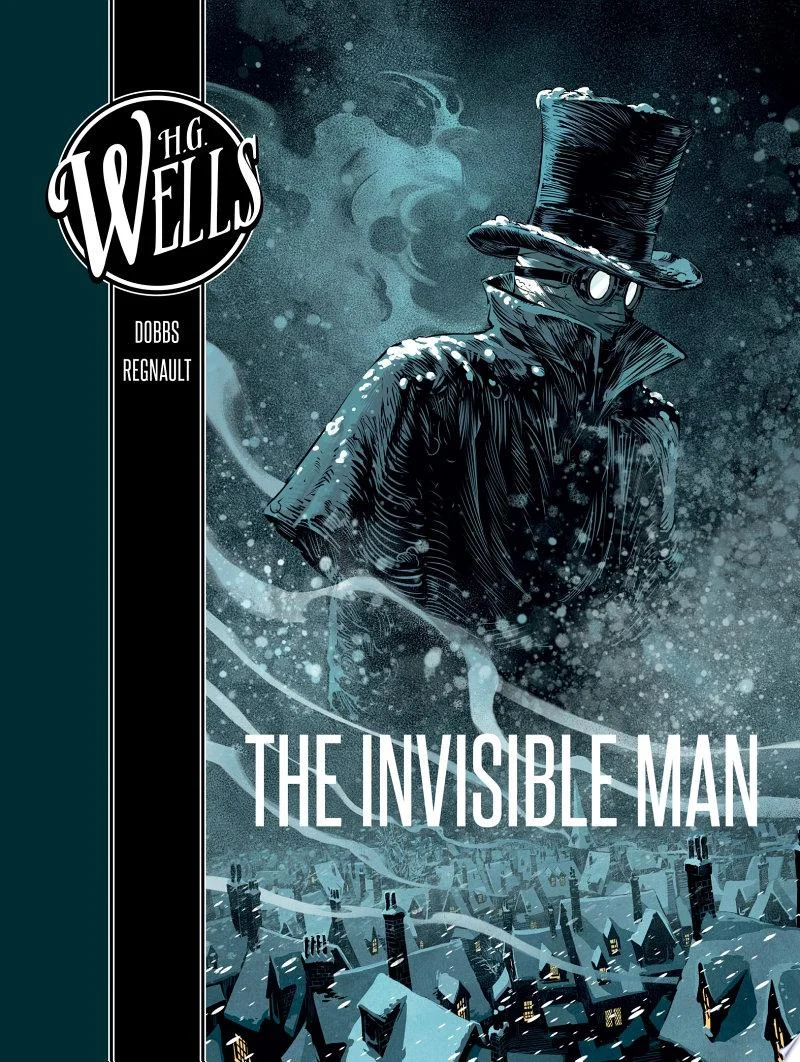
H. G. Wells: The Invisible Man
by Dobbs
- Publication Date:
- July 10th, 2018
- Publisher:
- Simon and Schuster
- ISBN-13:
- 9781683832119
- ISBN-10:
- 1683832116
- Pages:
- 116
Why H. G. Wells: The Invisible Man Has Been Challenged
Concerns raised about this title have less to do with its literary pedigree than with how starkly a graphic format can render menace and violence that a prose original leaves to the imagination. See more ↓
Challenged or banned in 1 state across 1 school district.
Overview
This graphic novel reimagines H.G. Wells's late-Victorian science fiction tale for a visual medium, translating its slow-building dread into panels and shadow. The story begins with an unexplained arrival: a bandaged, secretive traveler takes lodging in a sleepy rural village during a winter storm, unsettling the locals with his demand for privacy and his refusal to be seen. Curiosity curdles into suspicion as neighbors begin piecing together what he is hiding.
When the truth comes out, the villagers' fear turns into a chase, and the stranger's isolation gives way to something colder and more dangerous. What follows is less a triumphant unmasking than the unraveling of a man who has already lost his moral bearings, using his condition to threaten and terrorize the community that rejected him.
The adaptation compresses Wells's novel into a tighter, image-driven format, trading extended narration for visual atmosphere while retaining the story's essential arc: a scientific marvel that isolates its discoverer, and an isolation that hardens into cruelty.
A Classic Refitted for New Readers
Wells wrote the original story in 1897, part of a run of scientific romances that also produced The Time Machine and The War of the Worlds. Read together, those books share a preoccupation with what happens when human ambition outpaces human restraint. The invisible man's tragedy is not merely that he vanishes physically, but that he becomes unaccountable — freed from being seen, he stops answering to any community, any law, any conscience.
Graphic novel adaptations of public-domain literary classics occupy a particular niche in publishing and education: they are frequently used to introduce reluctant or younger readers to canonical texts, offering a faster entry point into stories otherwise associated with dense nineteenth-century prose. That crossover appeal — equal parts literary heritage and genre horror, delivered in an accessible visual format — is central to why this edition has found its way onto classroom and library shelves alongside more traditional prose editions.
Why H. G. Wells: The Invisible Man Has Been Challenged
Adaptations of literary classics are usually praised for making difficult or dated source material approachable, and this one has generally been received in that spirit — as a faithful, well-crafted gateway to Wells's original. Yet the same qualities that make it accessible are what draw scrutiny: stripped of extended prose exposition, the graphic format renders the story's violence and menace directly on the page, in imagery rather than description.
Objections have centered on that visual intensity — the depiction of a threatening, unstable figure who uses fear and physical harm to control the people around him — and on questions about whether the horror genre itself belongs in collections aimed at younger readers. Because the book is a graphic novel, some challenges also reflect a broader unease with the format: the concern that pictures make disturbing content more immediate or more explicit than the same content would be in text alone. In this catalog, the title has been the subject of a challenge in 1 state and 1 school district, reflecting a narrower, more localized pattern of concern rather than a widespread campaign against the work.
Where to Buy




Affiliate links may generate a small commission at no extra cost to you, which helps support this site.
Banned in Schools
Banned or challenged in 1 state across 1 school district.
Tennessee 1 district
- Wilson County Schools Banned