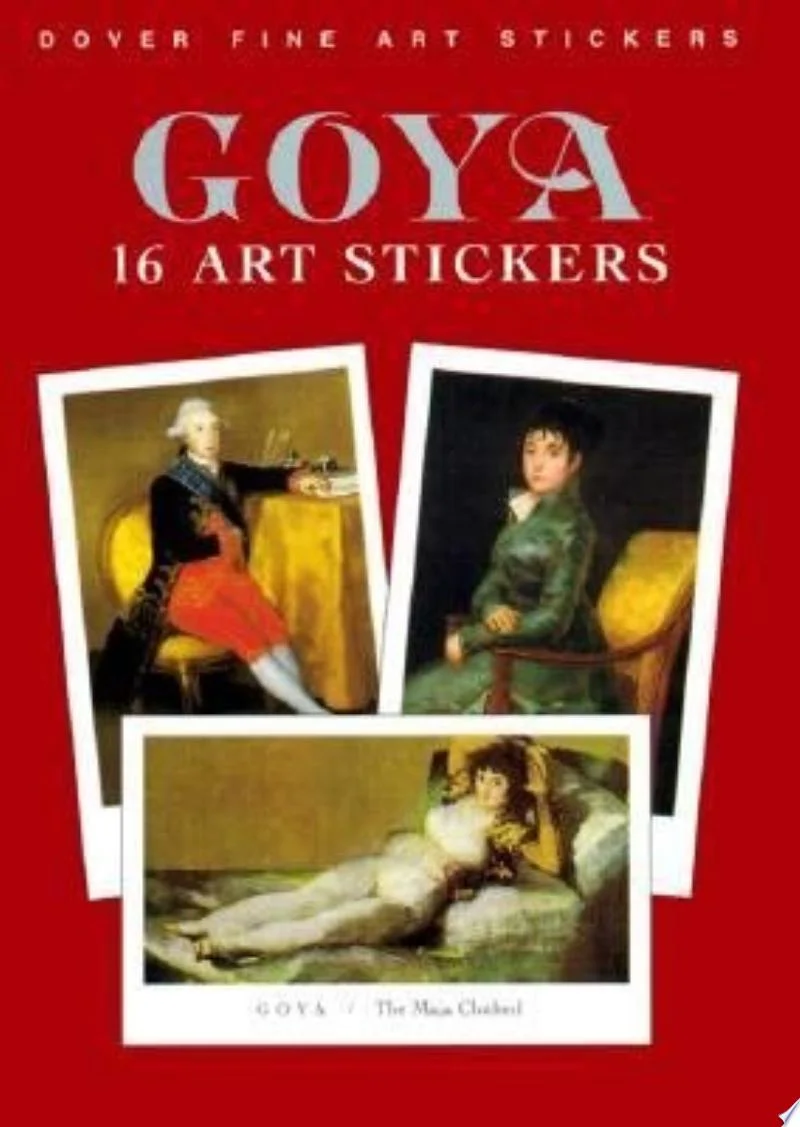
Goya
- Publication Date:
- June 1st, 2000
- Publisher:
- Courier Corporation
- ISBN-13:
- 9780486410753
- ISBN-10:
- 0486410757
- Pages:
- 12
Why Goya Has Been Challenged
Objections to this collection have centered on the frankness of Goya's imagery rather than on any single storyline, since the book is a compilation of reproductions rather than a narrative work. See more ↓
Challenged or banned in 1 state across 1 school district.
Overview
This volume gathers reproductions of Francisco Goya's paintings, tracing an arc from elegant court portraiture to some of the most unsettling images in Western art. Works like The Parasol and The Duchess of Alba represent Goya at his most decorative, capturing the manners and vanities of Spanish aristocracy with a painter's eye for fabric, light, and social performance.
Alongside these gentler scenes sit far darker canvases. The Third of May depicts the summary execution of Spanish civilians by Napoleonic troops, rendered with a rawness that broke from the heroic conventions of war painting that came before it. The Maja Clothed, paired historically with its unclothed counterpart, adds a note of controversy tied to censorship battles Goya faced in his own lifetime.
Taken together, the reproductions in this collection function less as a tidy retrospective and more as a survey of contradictions: a court painter who also recorded atrocity, a chronicler of pleasure who became one of art history's sharpest witnesses to violence.
An Artist Between Two Worlds
Goya's career is often read as a hinge point between the ornamental traditions of the eighteenth century and the psychological, unvarnished realism that would follow in the nineteenth. His early success came from flattering the tastes of the Spanish crown and nobility, and paintings such as The Duchess of Alba reflect that world of commissioned likeness and courtly display. But Goya's later work, shaped by war, illness, and personal disillusionment, moved toward subjects that refused to flatter anyone.
The Third of May is frequently cited as a turning point in how art depicts violence: rather than glorifying combat, it centers the fear and helplessness of the condemned, using stark lighting to strip the scene of nobility. This shift toward unidealized truth-telling is part of why Goya's body of work continues to be studied as a bridge to modern art, and why a single collection spanning his career can feel like two different painters in dialogue with each other.
Why Goya Has Been Challenged
Objections to this collection have centered on the frankness of Goya's imagery rather than on any single storyline, since the book is a compilation of reproductions rather than a narrative work. The Third of May's unsparing depiction of execution has drawn concern as disturbing or violent content, particularly in contexts where the audience includes younger students encountering it without extensive historical framing. Separately, the inclusion of The Maja Clothed has invited scrutiny tied to its companion piece, the more famous nude version of the same subject, and to broader discomfort with the human body in classical portraiture being placed in front of younger readers. These are the kinds of concerns that typically accompany reproductions of historical fine art in school and library settings, and they account for the single state and single district challenge recorded for this title in this catalog.
Where to Buy




Affiliate links may generate a small commission at no extra cost to you, which helps support this site.
Banned in Schools
Banned or challenged in 1 state across 1 school district.
Tennessee 1 district
- Oak Ridge Schools Banned