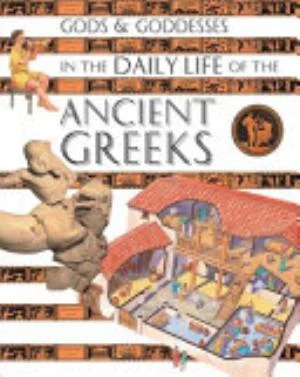
Gods & Goddesses in the Daily Life of the Ancient Greeks
- Publication Date:
- January 1st, 2013
- ISBN-13:
- 9781907184932
- ISBN-10:
- 1907184937
Why Gods & Goddesses in the Daily Life of the Ancient Greeks Has Been Challenged
Critics have taken issue with a children's reference book treating an ancient polytheistic faith as a serious, functioning belief system rather than safely distanced myth. See more ↓
Challenged or banned in 1 state across 1 school district.
Overview
Fiona Macdonald's illustrated volume approaches Greek mythology from an unusual angle: rather than retelling the famous stories, it asks what it actually meant to live among people who believed Zeus, Athena, and Poseidon governed the world. Through annotated artwork and short explanatory sidebars, the book walks readers through temples, festivals, oracles, and household shrines, treating religion as a lived practice rather than a collection of tales.
The format favors browsing over narrative. Each spread isolates a different facet of worship — how a sacrifice was performed, what a priestess's duties looked like, why certain gods were invoked for certain occasions — so that readers assemble a picture of ancient belief piece by piece rather than following a single storyline.
As a reference-style introduction, the book sits comfortably alongside classroom units on ancient civilizations, offering a visual entry point into a culture's worldview rather than a dense historical text.
Religion as Everyday Life
What distinguishes this book from a typical mythology collection is its insistence that Greek religion was inseparable from daily routine. Macdonald's structure keeps returning to the household, the marketplace, and the civic calendar, showing that invoking a god was not a mythic flourish but an ordinary act — a farmer appeasing Demeter before planting, a sailor praying to Poseidon before a voyage. This framing situates the book within a broader tradition of children's nonfiction that uses ancient religion as a lens for teaching how belief systems organize a society, rather than as entertainment or doctrine.
That approach also means the book inevitably touches on the darker and stranger corners of Greek worship — the violence of sacrifice, the moral ambiguity of a pantheon that could be petty and vengeful, and the sheer foreignness of polytheism to readers raised in different traditions. The book does not shy from presenting the gods as the Greeks understood them: powerful, flawed, and demanding.
Why Gods & Goddesses in the Daily Life of the Ancient Greeks Has Been Challenged
A parent raising a formal objection to this title argued that a children's book should not present a polytheistic religious system in such matter-of-fact, almost instructional detail, worrying that young readers might absorb the material as something closer to religious instruction than history. The concern centered less on any single image or passage than on the book's overall framing of ancient worship as a functioning belief system worth understanding on its own terms, rather than as myth clearly separated from real religious practice.
Underlying this objection is a broader discomfort that recurs whenever children's nonfiction treats a non-Christian religion with the same descriptive seriousness normally reserved for world history or anthropology. Depictions of sacrifice and the gods' capricious, sometimes violent behavior toward mortals have also drawn scrutiny from those who feel such content is inappropriate for the intended age group, even when presented as historical fact rather than endorsement. The book has been formally challenged in 1 state and 1 school district within records tracked by this catalog, reflecting a narrow but notable instance of pushback against educational material on ancient religion.
Where to Buy



Affiliate links may generate a small commission at no extra cost to you, which helps support this site.
Also by Fiona Macdonald

Banned in Schools
Banned or challenged in 1 state across 1 school district.
Tennessee 1 district
- Oak Ridge Schools Banned