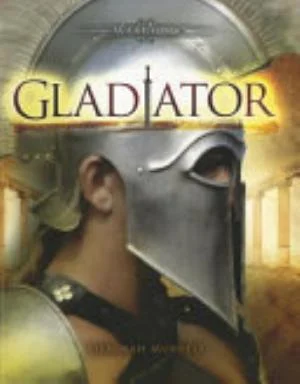
Gladiator
- Publication Date:
- January 1st, 2011
- Publisher:
- W.B. Saunders Company
- ISBN-13:
- 9781926853529
- ISBN-10:
- 1926853520
- Pages:
- 32
Why Gladiator Has Been Challenged
A single district raised concerns that the book's detailed treatment of combat and weaponry was too graphic for the shelf it occupied. See more ↓
Challenged or banned in 1 state across 1 school district.
Overview
Gladiator is one installment in a nonfiction series aimed at young readers who are drawn to action and spectacle rather than dry recitation of dates. Deborah Murrell builds the book around the figure of the Roman gladiator, using that role as an entry point into the broader machinery of ancient combat: how fighters trained, what they wore into the arena, and how contests were staged for a watching public.
The series format extends across related volumes covering hoplites, samurai, and medieval knights, and this entry follows the same structure: short profiles of notable figures, explanations of battle tactics, and close attention to the tools of fighting, from swords and shields to the specialized armor matched to different arena styles. Illustrations, photographs, fact boxes, and timelines break up the text, keeping the material accessible to readers who might otherwise avoid a conventional history book.
Rather than presenting Roman history as a continuous narrative, the book works more like a visual reference, built for browsing as much as for reading cover to cover. Its aim is less about comprehensive historical analysis than about making an ancient and often brutal profession vivid and comprehensible to a young audience.
A Window Into the Appeal of Ancient Combat
The gladiator occupies a curious place in popular memory: simultaneously a victim of a violent spectacle and a figure of skill, discipline, and celebrity within Roman society. Murrell's book leans into that duality by treating gladiatorial combat as a subject worth taking seriously on its own terms, alongside its counterparts in other warrior traditions, rather than something to sanitize or moralize about at length.
This approach reflects a broader trend in children's and middle-grade nonfiction publishing, where series built around warriors, weapons, and historical combat have found a reliable readership, particularly among reluctant readers who respond to high-interest, highly visual subject matter. Such books occupy a middle ground between pure entertainment and traditional history instruction, using the inherent drama of their subjects to build engagement with historical content, time periods, and material culture that might not otherwise capture a young reader's attention.
Why Gladiator Has Been Challenged
A parent raised the book with a school library review committee on the grounds that its depiction of how gladiators fought and died was not appropriate reading material for the age group it was shelved for, arguing that descriptions and images of weaponry and combat injuries went beyond what a children's history title should include. The complaint centered less on historical accuracy than on the level of graphic detail devoted to violence, with the argument that the book's visual, fact-driven format made disturbing content more vivid and memorable rather than less. This concern sits within a recognized pattern affecting illustrated military and combat history titles for young readers, where books praised for making history engaging are sometimes challenged on the same grounds: that vividness, applied to violent subject matter, can read as glorification rather than education. In this catalog, the book has been documented as challenged in one state and one district.
Where to Buy




Affiliate links may generate a small commission at no extra cost to you, which helps support this site.
Also by Deborah Murrell

Banned in Schools
Banned or challenged in 1 state across 1 school district.
Tennessee 1 district
- Monroe County Schools Banned