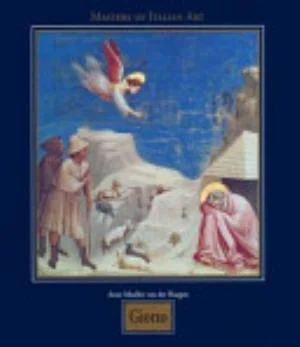
Giotto Di Bondone, about 1267-1337
by Anne Mueller
- Publication Date:
- January 1st, 1998
- Publisher:
- Konemann
- ISBN-13:
- 9783829002493
- ISBN-10:
- 3829002491
- Pages:
- 140
Why Giotto Di Bondone, about 1267-1337 Has Been Challenged
A challenge to this title took issue with reproducing centuries-old religious frescoes depicting nudity and suffering in a book aimed at young readers, regardless of the artwork's historical standing. See more ↓
Challenged or banned in 1 state across 1 school district.
Overview
This biography introduces young readers to Giotto di Bondone, the Italian painter whose work in the late thirteenth and early fourteenth centuries is often credited with pulling European art away from the flat, symbolic style of the Byzantine tradition and toward something more observational and human. Rather than a scholarly monograph, the book follows the format common to illustrated artist biographies for children: a life story paired with reproductions of the artist's paintings, meant to give a young audience both a narrative and a visual vocabulary for understanding a distant historical figure.
Anne Mueller's account traces Giotto's rise from craft apprentice to the most sought-after painter of his era, one whose frescoes decorated chapels and churches across central Italy. The book leans on the handful of details that survive about his life and training, using them as scaffolding for a broader introduction to how painting, patronage, and religious storytelling intersected in the medieval world he worked in.
As with other entries in this kind of series, the emphasis falls less on exhaustive biographical certainty—much about Giotto's early life remains disputed among historians—and more on making his surviving work accessible and legible to readers encountering it for the first time.
Giotto's Place in Art History
Giotto occupies an unusual position in the history of Western painting: medieval by training and religious commission, yet frequently described as a forerunner of the Renaissance for the weight, emotion, and spatial depth he brought to figures that earlier painters had rendered as flat and iconic. His fresco cycles, most famously those depicting the lives of Christ and the Virgin, are still cited by art historians as a turning point in how painters approached the human body and human feeling.
Books that introduce children to this period inevitably have to reckon with the fact that Giotto's surviving output is almost entirely religious and often physically unflinching—scenes of suffering, judgment, and martyrdom were standard subject matter for a fresco painter working for the Church. A biography aimed at young readers has to decide how much of that material to show and how to contextualize it, which is part of what makes this corner of art-history publishing more contested than it might first appear.
Why This Book Has Been Challenged
A complaint lodged against the book centered on the reproductions of Giotto's frescoes themselves, arguing that scenes drawn from his depictions of the Last Judgment and other religious narratives—figures rendered nude or in states of torment—were not suitable for display on elementary or middle-grade shelves, whatever their standing as art history. The objection framed the issue less as a question of artistic merit and more as one of age-appropriateness, holding that reproduced religious imagery involving nudity or suffering warranted the same scrutiny as any other visual content aimed at children, regardless of the painting's seven-hundred-year pedigree.
That argument reflects a recurring friction in how art-education materials for young readers are received: the same frescoes praised in museums and art-history surveys can read very differently once they're placed in a picture book on a school library shelf, where reviewers may weigh them against general content standards rather than art-historical context. In the one state and one district where this title has been formally challenged within this catalog's tracking, that tension between curatorial intent and local content review is what drove the objection, rather than any dispute about the book's factual accuracy or educational value.
Where to Buy




Affiliate links may generate a small commission at no extra cost to you, which helps support this site.
Banned in Schools
Banned or challenged in 1 state across 1 school district.
Tennessee 1 district
- Oak Ridge Schools Banned