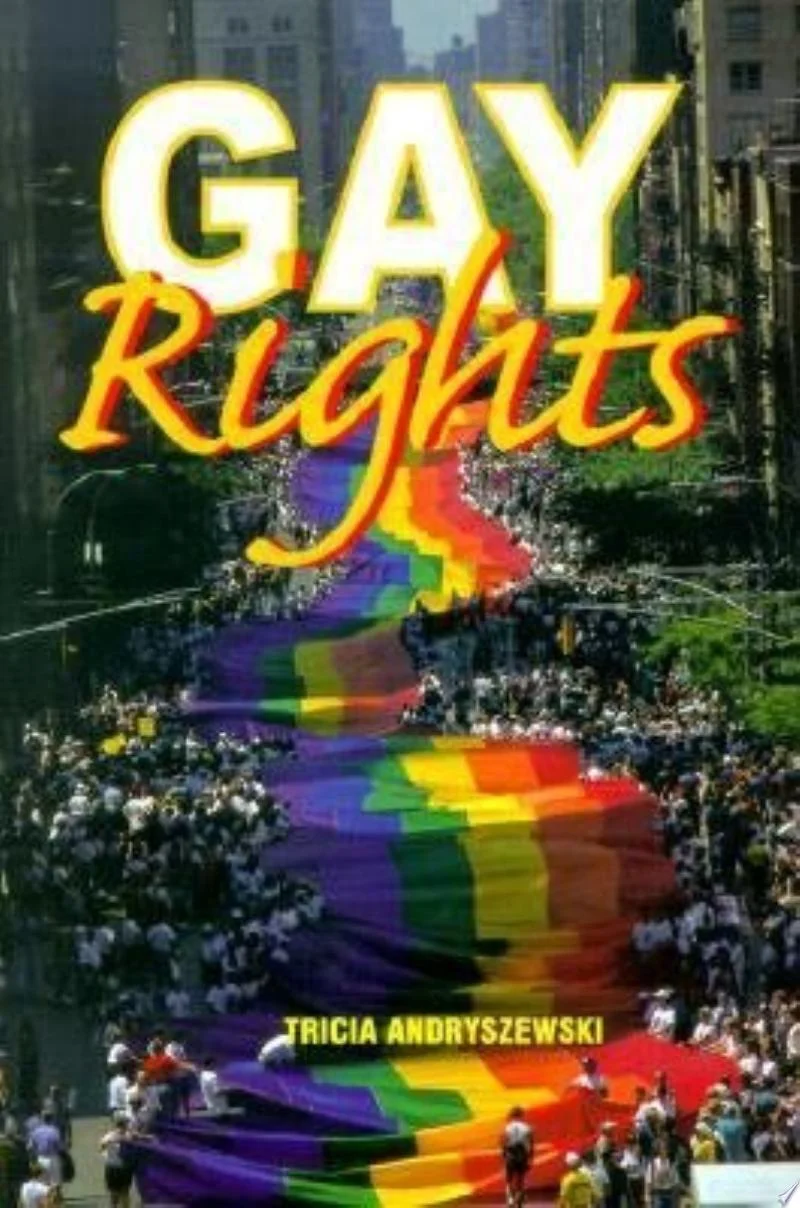
Gay Rights
- Publication Date:
- January 1st, 2000
- Publisher:
- Twenty-First Century Books
- ISBN-13:
- 9780761315681
- ISBN-10:
- 0761315683
- Pages:
- 124
Why Gay Rights Has Been Challenged
Critics have taken issue less with specific passages than with the book's basic premise, objecting to any classroom material that treats same-sex relationships and gay identity as ordinary subjects of American civil rights history. See more ↓
Challenged or banned in 1 state across 1 school district.
Overview
This nonfiction account surveys several decades of the gay rights movement in the United States, beginning with the 1969 uprising at the Stonewall Inn in New York City. Tricia Andryszewski uses that event as a hinge point, showing how a spontaneous act of resistance against police harassment galvanized a loosely organized community into sustained political and social action.
From there, the narrative moves through the following decades, tracking the movement's institutional growth, its setbacks, and its eventual gains in visibility and legal standing. It pays particular attention to the shifting public conversation around sexuality, discrimination, and civil rights as the twentieth century came to a close.
Written for younger readers as part of a broader series on social and political history, the book aims to distill a complex, contested chapter of American life into an accessible narrative, grounding abstract debates about rights and identity in specific people, organizations, and turning points.
A Movement in Context
The book arrives as part of a genre of youth-oriented civics and history writing that treats social movements as case studies in how change happens within a democracy. In framing gay rights alongside other rights struggles, Andryszewski situates the subject within a familiar historical pattern: a marginalized group organizing in response to exclusion, facing public and legal resistance, and gradually shifting both law and opinion.
What distinguishes this account from a purely celebratory retelling is its attention to the unevenness of that progress. The movement's history, as presented here, is not a straight line toward acceptance but a series of advances and reversals shaped by court decisions, public health crises, religious and political opposition, and internal debates within the community itself. That texture is part of what has made the book a useful, if contested, classroom resource for examining how civil rights movements actually unfold.
Why Gay Rights Has Been Challenged
The book's straightforward treatment of gay identity and same-sex relationships as a legitimate subject of civil rights history, rather than a matter of moral controversy, is the primary source of objection. Readers who challenge the book generally do so not over any single graphic passage but over its underlying premise: that the push for equal legal treatment of gay Americans belongs in the same historical frame as other civil rights struggles taught to young people. Some object to any affirming discussion of homosexuality in material aimed at students, regarding the subject itself as inappropriate for the intended age group regardless of how it is presented.
Other objections center on the book's implicit perspective, with critics arguing that a historical account sympathetic to the movement's aims amounts to advocacy rather than neutral instruction. These concerns echo broader disputes over how schools and libraries should handle topics tied to sexuality and identity. In the catalog tracked here, the book has drawn a challenge in one state and one district, reflecting a narrower but persistent pattern of objection tied less to its content specifics than to its subject matter as a whole.
Where to Buy




Affiliate links may generate a small commission at no extra cost to you, which helps support this site.
Banned in Schools
Banned or challenged in 1 state across 1 school district.