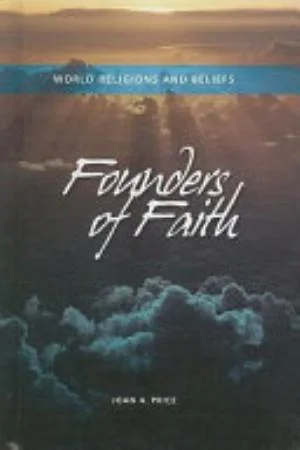
Founders of Faiths
by Joan Price
- Publication Date:
- January 1st, 2012
- Publisher:
- Morgan Reynolds Publishing
- ISBN-13:
- 9781599351476
- ISBN-10:
- 1599351471
Why Founders of Faiths Has Been Challenged
Presenting Jesus and Muhammad as historical figures alongside Krishna, the Buddha, and other religious founders has struck some challengers as an implicit leveling of traditions that, in their view, deserve to be treated differently. See more ↓
Challenged or banned in 1 state across 1 school district.
Overview
Founders of Faiths sets out to do something rarely attempted in a single illustrated volume for young readers: walk through the lives and ideas of seven people whose teachings gave rise to major religious traditions. Krishna, Abraham, the Buddha, Zoroaster, Confucius, Jesus, and Muhammad each receive their own treatment, moving from the circumstances of their lives into the core principles that followers built into lasting systems of belief and practice.
Joan Price structures each profile around the same basic questions — who this figure was, what they taught, and how that teaching took hold and spread. The approach favors clarity over depth, giving readers a map of each tradition's essential vocabulary and origin story rather than a full theological account. Illustrations accompany the text throughout, reinforcing names, settings, and symbols that recur across the different chapters.
The book's premise rests on a specific observation: that many readers, including adults, know only fragments of the traditions that shape the world around them, including their own. Rather than treating religious literacy as a specialist subject, Price frames it as basic cultural knowledge, useful for understanding neighbors, history, and the texts and holidays referenced constantly in everyday life.
Context and Reception
Comparative introductions to world religion occupy an unusual space in children's and middle-grade publishing. They are less common than single-faith educational materials, and they carry an implicit argument simply by their structure: that founders of different traditions belong on equal footing within one book, treated with the same tools of biography and explanation. That framing is itself part of what the book is doing — it asks readers to hold multiple belief systems in view at once, as historical and cultural phenomena rather than as a hierarchy of true and false.
The book's stated motivation, grounded in surveys of limited religious knowledge among the public, places it closer to a civics or cultural-literacy project than to devotional instruction. That distinction matters for how the book has been read and categorized by schools and libraries, which often shelve it as reference material for social studies or world history units rather than as religious education.
Why Founders of Faiths Has Been Challenged
The friction around this book tends to center on its structure rather than any single passage. By giving Jesus and Muhammad chapters of comparable length and format to Krishna, Zoroaster, and the Buddha, the book implicitly treats all seven as historical founders whose teachings can be summarized and compared side by side. For some readers, that equal-footing presentation reads as a neutral, descriptive choice suited to a general audience. For others, it reads as flattening distinctions between traditions they consider categorically different from one another, or as introducing children to religious frameworks their families have not chosen for them.
Because the book's content is informational rather than narrative, objections rarely point to a scene or specific line. Instead, they focus on the premise that a school or library shelf is an appropriate place for comparative religious content at all, particularly material covering Islam and other non-Christian traditions. According to the catalog data accompanying this entry, the book has drawn one formal challenge, recorded in one state and one school district.
Where to Buy




Affiliate links may generate a small commission at no extra cost to you, which helps support this site.
Banned in Schools
Banned or challenged in 1 state across 1 school district.
Tennessee 1 district
- Monroe County Schools Banned