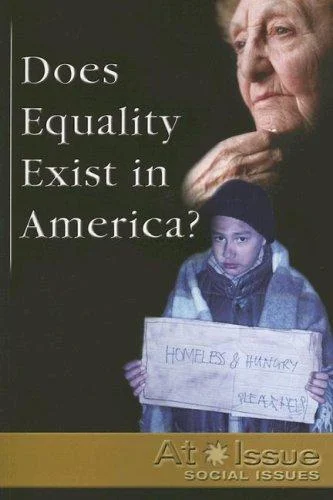
Does Equality Exist in America?
- Publication Date:
- August 26th, 2006
- Publisher:
- Greenhaven Press
- ISBN-13:
- 9780737734348
- ISBN-10:
- 0737734345
- Pages:
- 106
Why Does Equality Exist in America? Has Been Challenged
At issue for critics is less the accuracy of the book's statistics than the worry that simply laying out evidence of inequality nudges students toward one side of a debate it claims to leave open. See more ↓
Challenged or banned in 1 state across 1 school district.
Overview
"Does Equality Exist in America?" belongs to the genre of issues-based nonfiction written for student researchers and debaters rather than casual readers. Stuart A. Kallen, a prolific author of reference titles for young people, frames the book as an open question and builds his case through competing bodies of evidence: historical milestones in civil rights law, statistics on income and wealth gaps, and firsthand accounts of how race, gender, and class shape everyday opportunity.
Rather than delivering a single conclusion, the book is structured to let readers follow an argument and a counterargument side by side. Chapters likely move between legal gains, such as desegregation and voting rights, and the persistent gaps that remain in employment, housing, education, and the justice system, allowing students to see where consensus exists and where it breaks down.
The book's value lies less in telling readers what to think than in equipping them with vocabulary, statistics, and source material for their own essays, debates, and classroom discussions about one of the country's most contested questions.
A Question Built for the Classroom
Books like this one occupy a specific niche in school and public libraries: they exist to support research assignments, debate teams, and civics units, not to persuade through narrative. Kallen's broader body of work spans true crime, history, and social-issues titles aimed at middle and high school readers, and this entry fits that pattern by treating a politically charged subject as a research problem with multiple credible positions rather than a settled matter.
That framing has become more fraught in recent years as "equality," "equity," and related terms have themselves turned into flashpoints in public education. A title that simply compiles evidence on racial and economic disparity can be read very differently depending on the political climate in which it's shelved — as a neutral research tool by some, and as advocacy by others, regardless of how evenly the author balances the material.
Why Does Equality Exist in America? Has Been Challenged
A parent raising the book with a school board argued that presenting statistics on racial and economic disparity without equal space for arguments that such gaps are overstated amounts to steering students toward a predetermined political conclusion rather than letting them reach their own. That complaint reflects the central tension critics have raised: that a format built to look neutral — question posed, evidence weighed — can still read as an argument for one side once the evidence is assembled.
Other objections have focused on the appropriateness of introducing younger students to concepts like systemic bias, wealth inequality, and discrimination in the justice system at all, with some arguing the material is better suited to older students or should be left to classroom teachers to contextualize rather than placed on open library shelves. A smaller number of challenges have tied the book to broader anxieties about "critical race theory" and equity-focused curricula entering schools through the library rather than the classroom.
In the catalog tracked here, the book has drawn a challenge in one state and one school district, reflecting a narrow but pointed set of objections rather than widespread rejection.
Where to Buy




Affiliate links may generate a small commission at no extra cost to you, which helps support this site.
Banned in Schools
Banned or challenged in 1 state across 1 school district.