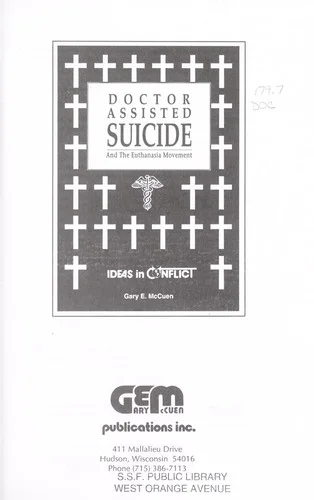
Doctor assisted suicide and the euthanasia movement
- Publication Date:
- March 1st, 1994
- Publisher:
- Gem Pubns
- ISBN-13:
- 9780865960930
- ISBN-10:
- 0865960933
Why Doctor assisted suicide and the euthanasia movement Has Been Challenged
Some parents and community members have objected to a young-adult reference book treating the choice to end one's own life as a legitimate two-sided policy question rather than a moral wrong. See more ↓
Challenged or banned in 1 state across 1 school district.
Overview
Gary E. McCuen's "Doctor Assisted Suicide and the Euthanasia Movement" belongs to his long-running series of issue-based anthologies built around a single format: pairing excerpted essays, editorials, and testimony from opposing sides of a contested social question so that readers can weigh the arguments themselves. Here the subject is the movement to legalize physician-assisted death, a debate that gained national visibility through court cases, ballot initiatives, and high-profile figures advocating for a legal right to end one's own life with medical assistance.
Rather than advancing a single narrative or thesis, the book assembles voices from medicine, law, religion, and disability advocacy, presenting arguments for patient autonomy alongside warnings about coercion, the sanctity of life, and the risks of expanding end-of-life options to vulnerable populations. The structure is deliberately dialectical, asking readers to hold competing claims in tension rather than resolving them.
As with other entries in McCuen's catalog, the book is aimed primarily at students and teachers using it for research papers, debate preparation, or classroom discussion of a live policy controversy, rather than at general readers seeking a single authoritative account.
Context and Significance
The book sits within a body of work McCuen produced across decades covering flashpoint issues in American public life, from capital punishment to reproductive rights, each volume following the same pro-and-con compilation model. Its treatment of euthanasia and assisted suicide reflects a period when the right-to-die movement moved from the margins of medical ethics into mainstream legislative and judicial debate, as states began considering laws permitting terminally ill patients to request lethal medication under specific safeguards.
The anthology's value for educators lies less in original argument than in curation: it functions as a primary-source reader that exposes students to the actual rhetoric used by advocacy organizations, physicians, ethicists, and religious leaders on both sides of the question. In placing autonomy-based arguments directly alongside sanctity-of-life and disability-rights objections, the book models the kind of structured disagreement that debate curricula are built to teach, even as the underlying policy question remains unsettled in much of the country decades later.
Why Doctor Assisted Suicide and the Euthanasia Movement Has Been Challenged
Discussions of suicide and end-of-life decision-making sit at the center of objections to this title, which has drawn a formal challenge in one state and one school district tracked in this catalog. Because the book presents arguments in favor of legalized assisted death without softening or filtering them for a younger audience, some challengers have viewed its inclusion of pro-euthanasia testimony as an implicit endorsement of suicide as a reasonable response to suffering, rather than as one side of a documented policy debate.
Religious and pro-life objectors have also pointed to the book's even-handed treatment of arguments they consider morally settled, arguing that presenting euthanasia as a legitimate subject for debate, rather than as a categorically wrong act, normalizes a practice they oppose on doctrine or conscience grounds. A related concern raised by some challengers involves age-appropriateness: the clinical and sometimes graphic detail found in first-person accounts of terminal illness and assisted death, reproduced from source material written for adult audiences, has been judged unsuitable for the students who might encounter the book in a school library setting.
Where to Buy




Affiliate links may generate a small commission at no extra cost to you, which helps support this site.
Also by Gary E. McCuen
Banned in Schools
Banned or challenged in 1 state across 1 school district.
Tennessee 1 district
- Monroe County Schools Banned