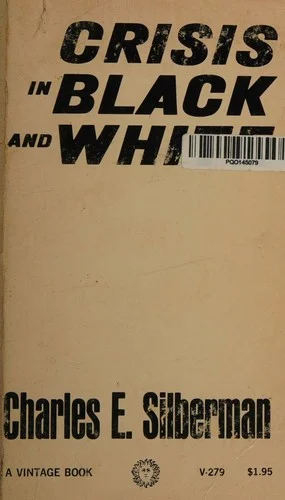
Crisis in black and white
- Publication Date:
- January 1st, 1964
- Publisher:
- Vintage Books
- ISBN-13:
- 9780394702797
- ISBN-10:
- 0394702794
- Pages:
- 370
Why Crisis in black and white Has Been Challenged
Debate over this book centers on its argument that responsibility for racial inequality rests with white institutions and attitudes, a framing some readers have rejected as an unfair collective indictment rather than a critique of specific policies. See more ↓
Challenged or banned in 1 state across 1 school district.
Overview
Charles E. Silberman's Crisis in Black and White arrived in the middle of the civil rights era as an attempt to explain, for a largely white readership, why the country's racial troubles were not a Southern anomaly but a national condition. Drawing on his background as a journalist and editor, Silberman moved between reportage and argument, surveying housing patterns, school systems, and civic institutions to make the case that segregation and inequality were sustained as much by Northern indifference as by Southern law.
The book's central claim is a reversal of the framing common at the time: rather than treating racial inequality as a "Negro problem" requiring Black Americans to adapt or improve themselves, Silberman insisted that the problem originated in white attitudes, white institutions, and white unwillingness to relinquish accumulated advantage. That inversion structures much of the book's analysis, from its account of urban ghettos to its skepticism toward incremental reform.
Published at a moment of rising activism and rising backlash alike, the book functioned as both explanation and provocation, asking readers who considered themselves sympathetic to civil rights to examine their own complicity in the systems it described.
Context and Reception
Silberman wrote as an outsider to the academy, and that journalistic sensibility shaped the book's reach. It was pitched not at specialists but at the broad, educated public that made up the readership of magazines like Fortune, where Silberman had worked, and it found an audience among readers grappling with the images of protest and resistance dominating the news. Its arguments fit into a wider current of mid-1960s writing that pressed white Americans to see racism as structural rather than incidental — a current that included government reports and sociological studies examining the same terrain from different angles.
Within Silberman's own body of work, the book marked an early turn toward large-scale institutional inquiry that he would continue in later studies of education and criminal justice. Read today, Crisis in Black and White is often approached as a period document: a record of how one prominent strand of white liberal opinion tried to reckon with segregation, inequality, and the limits of gradualism just as the civil rights movement was reaching its most consequential legislative victories.
Why Crisis in Black and White Has Been Challenged
The book's insistence that racism is a defect of white society rather than a deficiency of Black communities is the source of most objections to it. Readers uncomfortable with that framing have pushed back against passages that assign responsibility for segregation, unequal schooling, and housing discrimination squarely to white institutions and white choices, arguing that this amounts to indicting an entire group rather than describing specific policies or actors. Others have objected to the book's blunt treatment of historical racism and its refusal to soften the record for the sake of a more comforting narrative of gradual, harmonious progress.
Because the book was written to unsettle its white readers rather than reassure them, some of the material that provoked debate on publication — its critique of Northern liberalism, its portrayal of ghetto conditions as the product of deliberate exclusion rather than accident — is the same material that has drawn renewed scrutiny in more recent efforts to limit how race and American history are discussed in schools. In this catalog, that scrutiny has resulted in a single tracked challenge, spanning one state and one district.
Where to Buy




Affiliate links may generate a small commission at no extra cost to you, which helps support this site.
Banned in Schools
Banned or challenged in 1 state across 1 school district.
Tennessee 1 district
- Monroe County Schools Banned