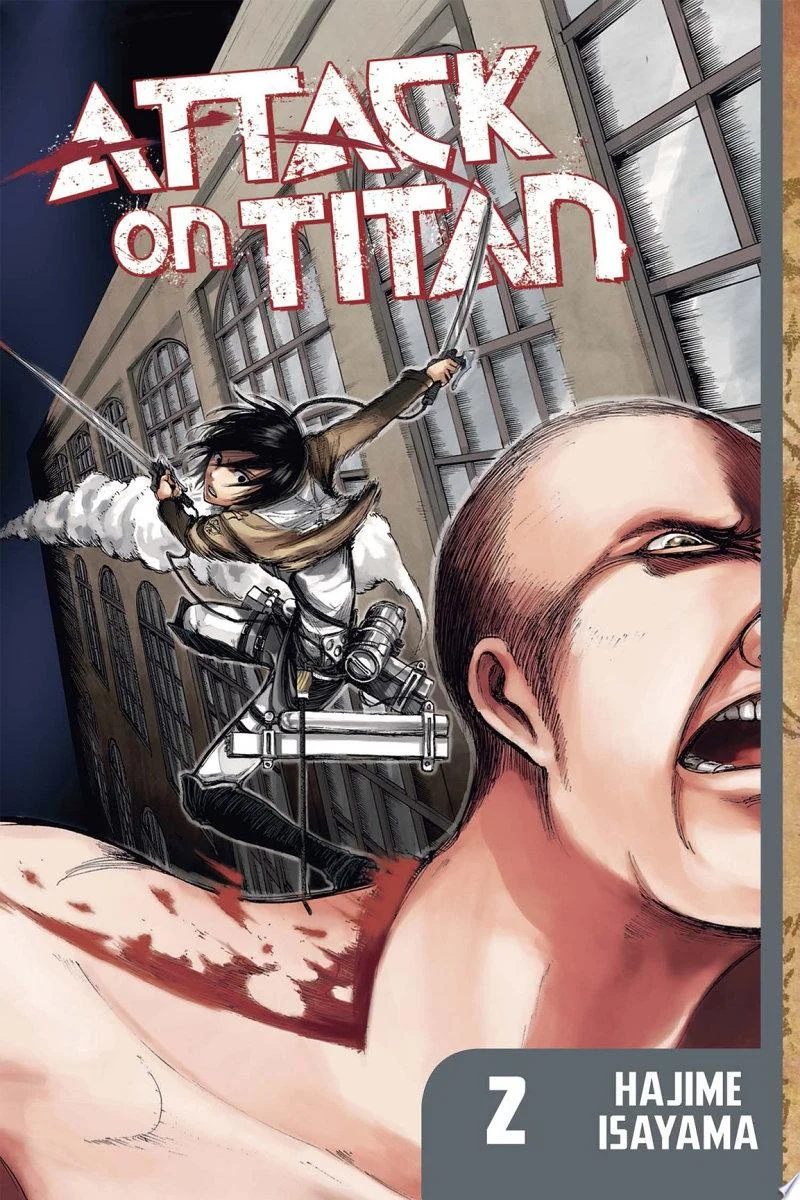
Cover of Attack on Titan

Attack on Titan

by Hajime Isayama

2013 Kodansha Comics 194 pages English
Publication Date:
July 16th, 2013
Publisher:
Kodansha Comics
ISBN-13:
9781612626161
ISBN-10:
1612626165
Pages:
194

Why Attack on Titan Has Been Challenged

Parents and administrators have pushed back on this volume mainly over its unflinching depictions of bodies being devoured and torn apart, arguing the imagery is too graphic for the young readers who gravitate toward the series. See more ↓

Challenged or banned in 1 state across 1 school district.

<h2>Overview</h2> <p>This installment of Hajime Isayama's saga picks up in the aftermath of catastrophe: the Colossal Titan has broken through Wall Maria, humanity's outermost barrier against the monstrous forces outside. With that defense gone, survival now rests on a thin line of trained soldiers, among them Mikasa Ackerman, the standout fighter of the 104th Training Corps and Eren Yeager's closest companion.</p> <p>Mikasa's battlefield composure masks a history she rarely speaks of, one that resurfaces as the stakes rise and her reasons for fighting come into sharper focus. Into this crisis arrives an unexpected variable: a Titan unlike the others, one that turns its violence on its own kind rather than on humans.</p> <p>Isayama leaves the nature of this new arrival deliberately ambiguous, inviting readers to wonder whether it represents salvation or a danger still more difficult to name. The volume closes out with bonus material extending beyond the main narrative.</p> <h2>A Series Built on Dread and Ambiguity</h2> <p>Attack on Titan built its reputation on refusing easy comfort. Rather than offering a clear enemy to defeat, the series repeatedly complicates who the real threat is, using the Titans as a shifting symbol for fear, dehumanization, and the walls societies build to keep out what they don't understand. This volume sits at a hinge point in that approach, introducing a Titan whose loyalties and motives can't be read at a glance.</p> <p>Mikasa's backstory, hinted at here, is part of a broader pattern in the manga: nearly every character's resolve is traced back to loss, trauma, or compromise, and the story treats violence as something that shapes people rather than something that simply happens to them. That approach helped the series become one of the most widely read manga of its era, translated into numerous languages and adapted into an anime watched well beyond its original audience, while also making it a frequent subject of debate about how much horror a coming-of-age story should carry.</p> <h2>Why Attack on Titan Has Been Challenged</h2> <p>Most objections to this volume point to middle-school-aged readers, the age group most often named in library and classroom complaints, and argue that the material is too intense for them to encounter without adult guidance. Specifically, critics focus on the series' visceral battle sequences, in which Titans consume and dismember human characters in detail that goes well beyond implication, and on the body horror inherent to the Titans' design.</p> <p>Some challenges also cite the broader emotional weight of the story, including its portrayal of grief, soldiers' deaths, and the psychological toll of constant combat, as inappropriate for younger teens even when the violence itself is not the central complaint. In this catalog, the book has been the subject of 1 challenge spanning 1 state and 1 school district, consistent with how the series' graphic content has drawn scrutiny in a small number of individual school and library settings rather than broad, coordinated bans.</p>

Where to Buy

Affiliate links may generate a small commission at no extra cost to you, which helps support this site.

Also by Hajime Isayama
Banned in Schools

Banned or challenged in 1 state across 1 school district.