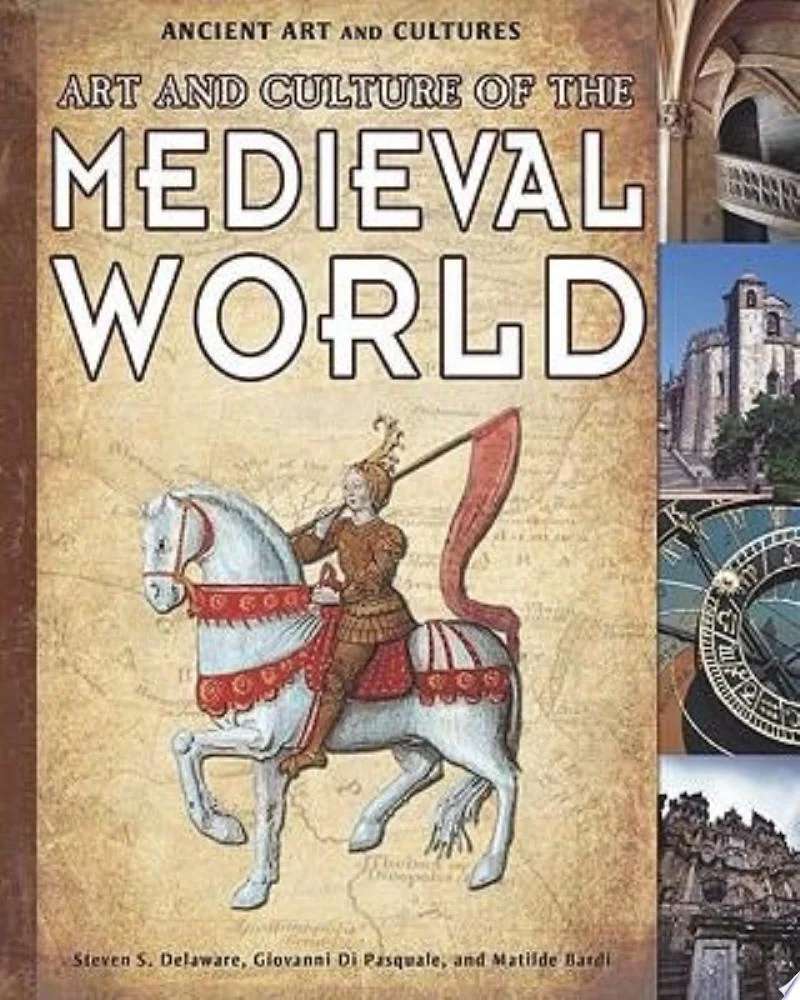
Art and Culture of the Medieval World
- Publication Date:
- January 15th, 2010
- Publisher:
- The Rosen Publishing Group, Inc
- ISBN-13:
- 9781615329618
- ISBN-10:
- 1615329617
- Pages:
- 43
Why Art and Culture of the Medieval World Has Been Challenged
Critics have taken issue less with historical accuracy than with the book placing two major faith traditions on equal footing and reproducing period artwork some find too weighty in subject matter for younger readers. See more ↓
Challenged or banned in 1 state across 1 school district.
Overview
Steven S. Delaware's "Art and Culture of the Medieval World" is a richly illustrated introduction to the centuries between the fall of Rome and the dawn of the Renaissance. Rather than marching through kings and battles alone, the book uses artwork, artifacts, and photographs as its primary evidence, letting readers see the period through the objects its people actually made and used.
The narrative follows two of the era's most powerful institutions as they expand across the map: the Catholic Church in western Europe and the Islamic empire stretching from Iberia to Central Asia. Delaware treats these not as background scenery but as engines of the period's art, architecture, and intellectual life, tracing how faith shaped everything from manuscript illumination to city planning.
Woven between these larger threads is a portrait of ordinary existence: what people ate, built, wore, and believed in a world without the conveniences or certainties of modern life. The effect is a book that treats the Middle Ages less as a "dark age" and more as a period of genuine creative and cultural ferment.
A Wider Lens on a Misunderstood Era
Popular imagination often flattens the medieval period into a single story of ignorance and decline sandwiched between the classical world and the Renaissance. Delaware's book pushes against that inherited narrative by insisting on the era's visual and material richness, using illustration as an argument in itself: a civilization capable of producing the art and architecture depicted here cannot be dismissed as merely a placeholder in a longer story.
The book's decision to place the Catholic Church and the Islamic empire side by side is also a quiet corrective to histories that treat medieval Europe in isolation. By showing these civilizations developing in parallel and in contact with one another, Delaware situates European history within a broader Mediterranean and Eurasian context, reflecting a shift in how the period is taught in schools today, with more emphasis on global interconnection than on a single regional narrative.
Why Art and Culture of the Medieval World Has Been Challenged
A book built around the achievements of two major world religions inevitably invites scrutiny over how that material is presented, and reviewers have generally credited Delaware with an even-handed, historically grounded treatment rather than one favoring either faith. Even so, the book has drawn a formal challenge, recorded once in this catalog's tracking of one state and one district.
The core of the objection concerns how religion is handled in a work intended for younger readers: some challengers have argued that presenting the growth of the Catholic Church and Islamic empire as parallel, comparably significant developments amounts to an endorsement of religious traditions that families feel should be addressed at home rather than in an illustrated history text. Others have pointed to the book's visual material itself, since an art-centered survey of the period necessarily reproduces medieval imagery that can include religious iconography, depictions of warfare and persecution, and figural art that some readers find too mature or theologically loaded for a young audience without additional context or framing.
Where to Buy




Affiliate links may generate a small commission at no extra cost to you, which helps support this site.
Banned in Schools
Banned or challenged in 1 state across 1 school district.
Tennessee 1 district
- Monroe County Schools Banned