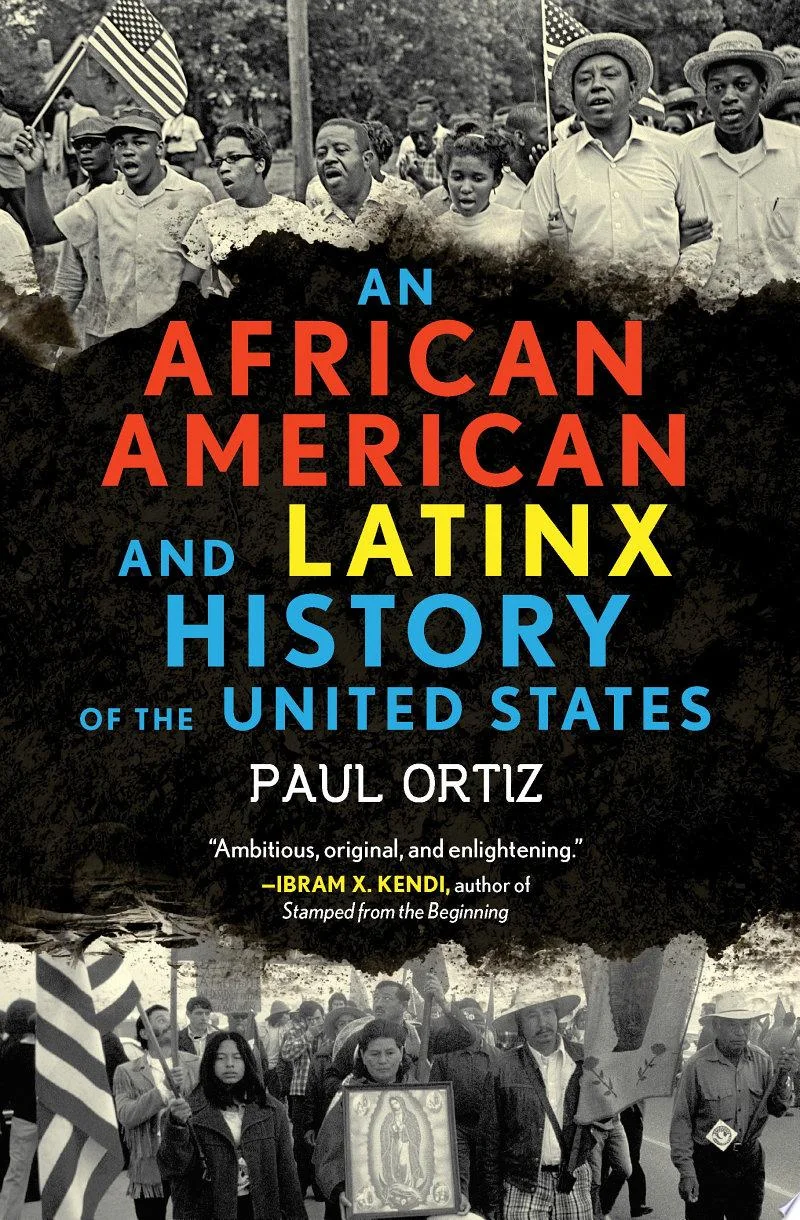
An African American and Latinx History of the United States
by Paul Ortiz
- Publication Date:
- January 30th, 2018
- Publisher:
- Beacon Press
- ISBN-13:
- 9780807013908
- ISBN-10:
- 0807013900
- Pages:
- 298
Why An African American and Latinx History of the United States Has Been Challenged
Some reviewers have balked at a history that casts U.S. expansion, immigration policy, and labor practices as forms of racial and economic exploitation rather than national achievement. See more ↓
Challenged or banned in 1 state across 1 school district.
Overview
Paul Ortiz's sweeping history reframes more than two hundred years of the American story by placing African American and Latinx experiences at its center rather than its margins. Rather than treating these as parallel but separate narratives, Ortiz traces the points where they intersect: shared organizing strategies, overlapping print cultures, and a common struggle against structures that confined both groups to the bottom of the nation's economic order.
The book moves from the segregated Southwest through the rise and suppression of Mexican labor unions in the twentieth century, arriving at the 2006 "Day Without Immigrants" demonstrations as a culminating expression of cross-cultural solidarity. Along the way, Ortiz draws on newspapers, speeches, and organizing records to show how abolitionists, labor activists, and Latin American revolutionaries built alliances that rarely appear in conventional textbook accounts.
Throughout, the book questions triumphalist framings of westward settlement, arguing instead that the political and economic development of the United States was inseparable from its relationship to the wider hemisphere—and from the people who resisted exploitation within it.
A History Told From the Ground Up
Ortiz writes as both a scholar and a longtime labor and civil rights organizer, and that dual perspective shapes the book's method: history assembled from the testimony and organizing of ordinary people rather than from the decisions of political leaders. The result is less a chronicle of legislation and more an account of how working people across racial lines built shared movements, often under conditions of surveillance and violent repression.
The book also positions itself against a resurgence of nationalist rhetoric in American politics, arguing that the historical record shows the opposite pattern—generations of Black and Latinx organizers consistently sought connection with movements elsewhere in the Americas rather than isolation from them. In doing so, Ortiz contributes to a broader current in recent historical writing that treats race, labor, and empire as interconnected rather than separate fields of study, and that insists U.S. history cannot be understood apart from its hemispheric context.
Why This Book Has Been Challenged
Its central argument—that American expansion and prosperity were built on the exploitation of African American and Latinx labor, and that concepts like manifest destiny served to justify that exploitation—has drawn objections from readers who view this framing as an unduly negative or politically slanted account of national history. Critics have specifically pointed to the book's treatment of immigration enforcement, labor suppression, and racial segregation as ongoing structures of harm, arguing that this emphasis amounts to indoctrination rather than historical instruction. Supporters counter that the book is grounded in primary sources and represents a legitimate, well-documented school of historical interpretation. In this catalog, the book has been the subject of challenge activity in one state and one school district.
Where to Buy




Affiliate links may generate a small commission at no extra cost to you, which helps support this site.
Banned in Schools
Banned or challenged in 1 state across 1 school district.