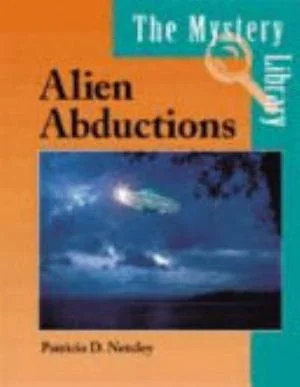
Alien Abductions
- Publication Date:
- January 1st, 2001
- ISBN-13:
- 9781560067672
- ISBN-10:
- 1560067675
Why Alien Abductions Has Been Challenged
Some parents and reviewers have questioned whether a book that treats alien abduction testimony as a serious subject of inquiry, rather than clearly labeling it as fringe belief, is appropriate reading for children still learning to separate documented fact from speculation. See more ↓
Challenged or banned in 1 state across 1 school district.
Overview
Patricia D. Netzley's "Alien Abductions" surveys one of ufology's most persistent subgenres: first-person accounts of people who say they were taken aboard extraterrestrial craft. The book anchors its discussion in the Hill case, the widely cited 1961 encounter often treated as the template for later abduction narratives, and uses it as a launching point for examining how such stories are told, investigated, and disputed.
From there, the book moves through the mechanics of evaluating a claim: what investigators look for when someone reports missing time or bodily marks, what has been offered over the decades as physical proof, and why that evidence rarely satisfies skeptics or scientists. It also turns inward, considering psychological explanations — sleep paralysis, suggestion, memory distortion — that some researchers use to account for abduction memories without invoking extraterrestrial visitors.
A closing line of inquiry asks the broader question behind the phenomenon: if abductions are real, what would motivate visitors to travel here and interact with humans at all. The book treats this as an open question rather than a settled one, consistent with its general approach of laying out competing explanations side by side.
A Case Study in Weighing Extraordinary Claims
The book belongs to a reference series aimed at young researchers navigating topics that sit at the edge of mainstream science, and its value lies less in any conclusion about extraterrestrial life than in the method it models. By walking through the same case from multiple angles — the original testimony, the search for corroborating evidence, and the alternative psychological accounts — it gives readers a working example of how a contested claim gets tested rather than simply accepted or dismissed.
That framing places the book closer to critical-thinking instruction than to paranormal advocacy. It treats belief and skepticism as two positions in an ongoing argument, inviting readers to notice which kind of evidence each side finds persuasive. In doing so, it also reflects a broader pattern in reference publishing for young readers: subjects like UFOs, cryptids, and ghost sightings are packaged not as entertainment but as case studies in evidence, testimony, and the limits of what can be proven.
Why Alien Abductions Has Been Challenged
Most objections on record cite the book's suitability for upper-elementary and middle-school readers, the age range at which it is typically shelved and assigned. Critics in that context argue that presenting abduction narratives alongside scientific-sounding analysis risks blurring the line between documented fact and speculative or fringe belief for readers who may not yet have the background to tell the two apart. Some raise concern that detailing alleged physical effects of abduction, such as missing time or unexplained marks, could unsettle younger children or feed anxiety rather than curiosity.
A related strand of objection centers on the book's neutral treatment of a topic some consider pseudoscience: by giving equal narrative weight to believers' testimony and skeptics' rebuttals, the book is accused of lending unearned credibility to claims that lack scientific consensus. Others counter that this even-handedness is precisely what makes the book useful as an exercise in source evaluation. The title has been challenged in one state and one district tracked in this catalog, reflecting a narrower and more localized pattern of objection than many frequently challenged titles.
Where to Buy



Affiliate links may generate a small commission at no extra cost to you, which helps support this site.
Banned in Schools
Banned or challenged in 1 state across 1 school district.
Tennessee 1 district
- Monroe County Schools Banned