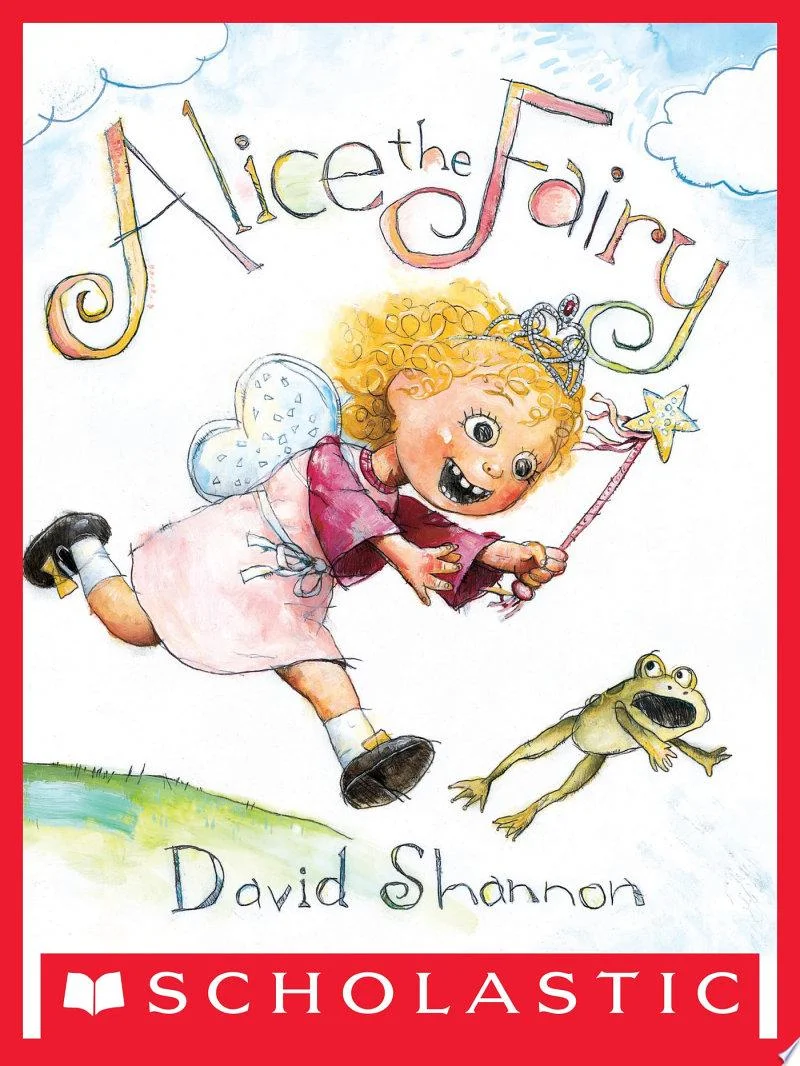
Alice the Fairy
by
David Shannon
2016
Scholastic Inc.
42 pages
English
- Publication Date:
- July 26th, 2016
- Publisher:
- Scholastic Inc.
- ISBN-13:
- 9780545529655
- ISBN-10:
- 0545529654
- Pages:
- 42
Why Alice the Fairy Has Been Challenged
Critics have taken issue with a fantasy where a child's tricks on her father and quiet theft of his cookies play out as purely charming, with no moment in the story suggesting that manipulating an adult or taking what isn't hers deserves any response at all.
See more ↓
Challenged or banned in
1 state
across
3 school districts.
<h2>Overview</h2>
<p>Alice has decided she is a fairy—not yet a fully credentialed one, but a "Temporary Fairy" building toward the real thing. Armed with a wand, a set of wings, and a trusty blanket doubling as a cape, she sets about reordering the world around her: vanishing at will, taking to the air, and turning her father into a horse when the mood strikes.</p>
<p>Her ambitions extend to her father's cookie plate, which she redirects toward herself with a flick of her wand and not a trace of guilt. It is the logic of a child's daydream rendered literal—rules bend, consequences soften, and desire becomes its own kind of magic.</p>
<p>Full fairy status, however, remains out of reach. Alice still can't get the family dog to hover near the ceiling, and her clothes stubbornly refuse to put themselves away. David Shannon renders this gap between aspiration and ability with warmth, turning a small girl's half-finished magic into a portrait of imagination still very much under construction.</p>
<h2>A Child's-Eye View of Power and Pretend</h2>
<p>Shannon built much of his career chronicling small children who test the boundaries of what they're allowed to do, and Alice extends that preoccupation into the register of fantasy. Where a book like <em>No, David!</em> catalogs a child's transgressions from the outside, <em>Alice the Fairy</em> narrates its own mischief from within—Alice isn't misbehaving, she's practicing a craft, and the distinction is the book's central joke.</p>
<p>The fairy premise gives Shannon a light structure for a familiar preschool truth: young children genuinely believe, at least provisionally, that wanting something enough might make it so. Alice's failures—the dog that won't float, the clothes that won't fold themselves—are as central to the book as her successes, keeping the story grounded in the comic realism of early childhood rather than in pure wish-fulfillment. It has endured as a read-aloud staple precisely because it takes a toddler's sense of self-importance seriously without ever losing its sense of humor about it.</p>
<h2>Why Alice the Fairy Has Been Challenged</h2>
<p>The moments that have drawn scrutiny are the ones where Alice's magic serves her own ends at someone else's expense: turning her father into a horse for her own amusement and spiriting his cookies onto her own plate, all narrated as charming rather than corrected. Some parents and reviewers have objected that the book presents a child's manipulation of adults and casual appropriation of things that aren't hers as endearing wish-fulfillment, with no narrative moment of comeuppance or parental response to signal that the behavior is anything other than delightful. For readers who look to picture books to model straightforward honesty and respect for others' belongings, Alice's untroubled trickery has registered less as harmless make-believe and more as a story that lets deception pass without consequence. The objection is less to fantasy and flying wands themselves than to what the fantasy is used for—bending a parent to a child's will and taking what belongs to someone else—concerns substantial enough to have generated 1 state and 3 district challenges logged in this catalog.</p>
Where to Buy
Affiliate links may generate a small commission at no extra cost to you, which helps support this site.
Banned in Schools
Banned or challenged in
1 state
across
3 school districts.