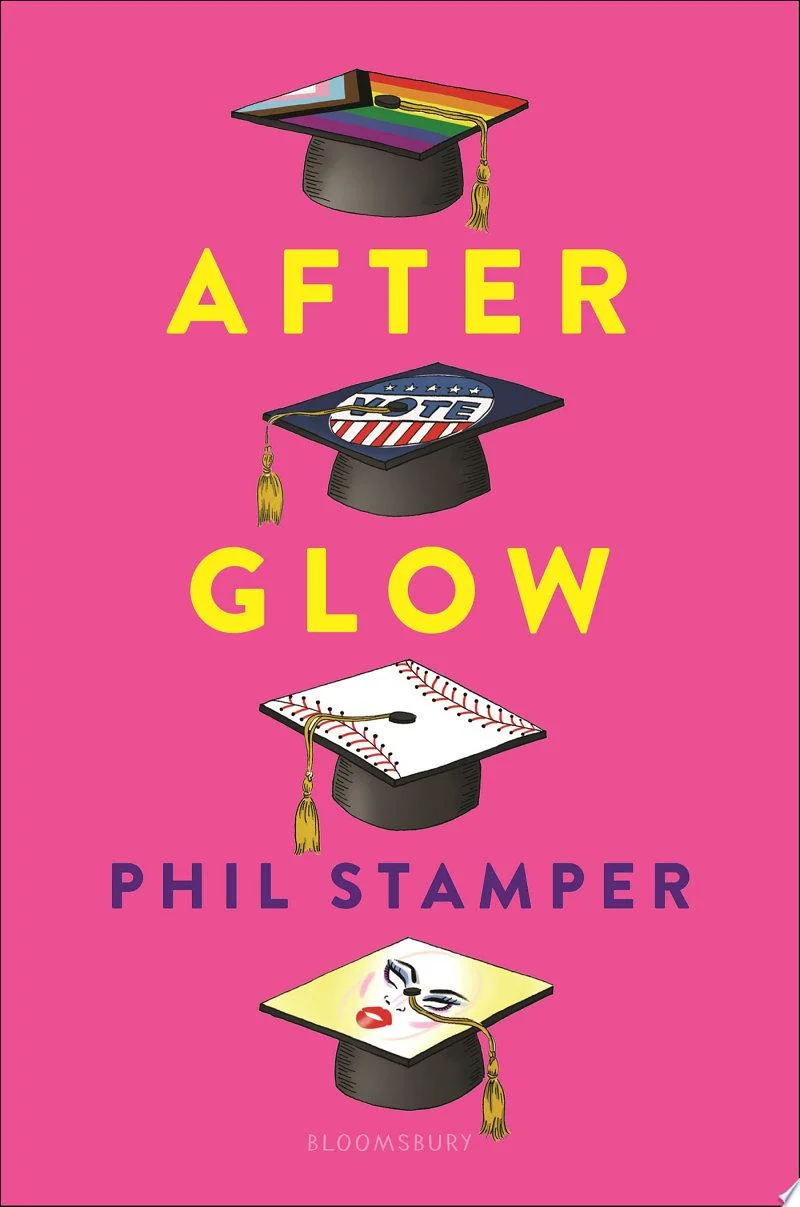
Afterglow
by Phil Stamper
- Publication Date:
- February 7th, 2023
- Publisher:
- Bloomsbury+ORM
- ISBN-13:
- 9781547608683
- ISBN-10:
- 1547608684
- Pages:
- 251
Why Afterglow Has Been Challenged
Critics who have sought to restrict this book generally object to its candid depiction of a teenage same-sex relationship and its open advocacy for LGBTQ+ student organizing, arguing such content doesn't belong in a school library. See more ↓
Challenged or banned in 1 state across 1 school district.
Overview
Afterglow picks up the story of four friends first introduced in Phil Stamper's The Golden Boys, moving them from the ease of summer into the pressure of senior year. Gabriel throws himself into founding his school's first LGBTQ+ advocacy group, even as the long-distance relationship that once felt like the center of his world begins to cool into something less certain. Heath, meanwhile, has found a stability he hasn't known in years, but a looming baseball scholarship turns every pitch into a test he can't afford to fail.
Reese and Sal are charting their own uneasy paths forward. Reese is committed to a future in fashion design, only to find his instincts pulling him somewhere he isn't ready to explain to anyone else yet. Sal, drawn to the idea of a career in politics, has a conversation with his aunt that nudges him toward a route he hadn't considered.
As the four approach graduation, the novel tracks how ambition, romance, and friendship strain against each other when everything is in motion at once. The book asks whether its characters can stay anchored to one another while each is quietly becoming someone new.
Growing Up Without Growing Apart
As the second half of a duology, Afterglow is less concerned with the discovery of identity than with what comes after it—the harder work of sustaining relationships, ambitions, and a sense of self once the initial excitement of self-acceptance has passed. Stamper uses the familiar architecture of the senior-year novel, with its scholarships, first real romantic disappointments, and plans for life after high school, to examine how queer teenagers in particular navigate visibility and vulnerability at a moment when they are also expected to decide who they'll become.
The novel's interest lies as much in its ensemble as in any single storyline. By dividing its attention among Gabriel, Heath, Reese, and Sal, it treats friendship itself as a subject worth dwelling on, showing how four people who came of age together can still be startled by how differently they each define success, love, and courage. That emphasis situates the book within a broader turn in recent YA fiction toward stories that follow queer characters past the "coming out" narrative and into the ordinary, unresolved business of adult life.
Why Afterglow Has Been Challenged
Most objections to the book cite its intended readership of high school students, arguing that a novel marketed to teenagers should not center same-sex relationships and the emotional and physical dimensions of dating as directly as this one does. Critics raising these concerns typically frame the book's frank treatment of a gay teenage romance, and its unambiguous advocacy for LGBTQ+ visibility in school settings, as material better suited to older readers or excluded from school libraries altogether.
Underlying these objections is a broader discomfort with young-adult fiction that normalizes queer identity as simply one thread among the ordinary concerns of adolescence—scholarships, career plans, family expectations—rather than treating it as an issue requiring special caution or framing. The book has been formally challenged in 1 state and 1 school district tracked in this catalog, reflecting the same pattern of objection seen elsewhere: not a dispute over literary merit, but over whether LGBTQ+ characters and relationships belong in shared school collections at all.
Where to Buy




Affiliate links may generate a small commission at no extra cost to you, which helps support this site.
Banned in Schools
Banned or challenged in 1 state across 1 school district.