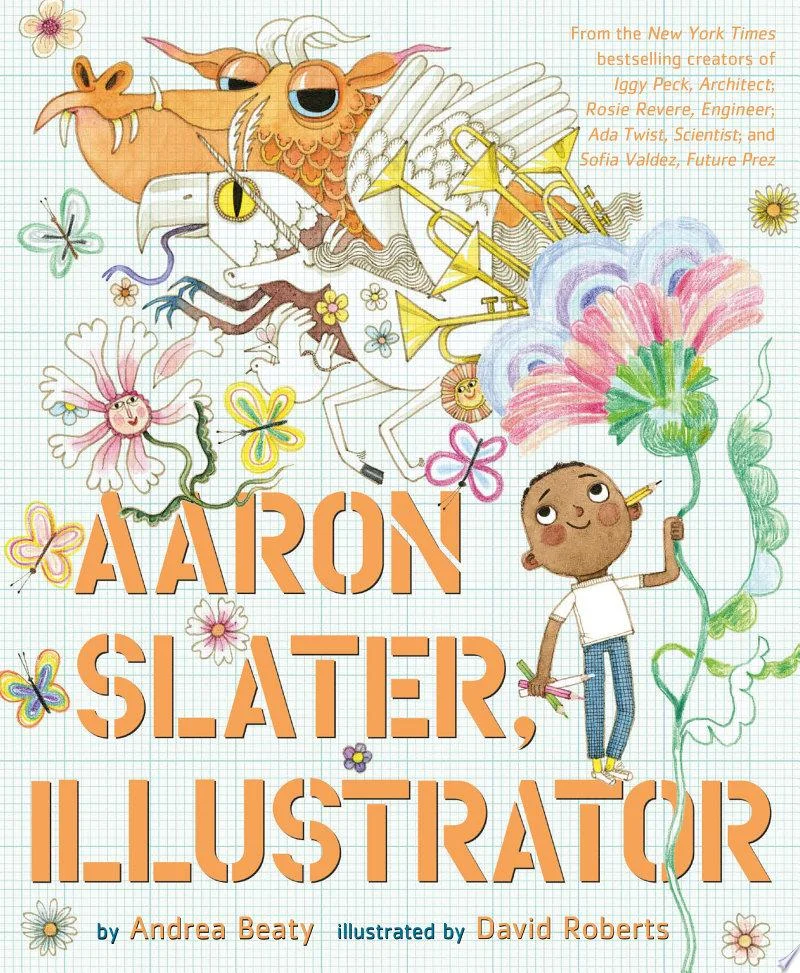
Aaron Slater, Illustrator
by Andrea Beaty
- Publication Date:
- November 2nd, 2021
- Publisher:
- Abrams
- ISBN-13:
- 9781647002718
- ISBN-10:
- 1647002710
- Pages:
- 52
Why Aaron Slater, Illustrator Has Been Challenged
Most objections have centered on whether a story built around dyslexia belongs in a shared classroom lesson at all, with some critics framing it as part of a wider curriculum push around identity and learning differences rather than judging the story on its own terms. See more ↓
Challenged or banned in 1 state across 1 school district.
Overview
Aaron Slater, Illustrator follows a boy whose love of being read to far outpaces his ease with reading on his own. Letters resist him in a way they don't seem to resist his classmates, and that gap grows harder to ignore once a writing assignment asks every student to produce a story of their own.
Faced with a blank page he can't fill the way he imagines his peers can, Aaron initially reads his own struggle as proof that storytelling isn't for him. The book turns on the moment he finds an alternate route to the same goal, one built from images rather than letters, and realizes that the story he wanted to tell was never out of reach, only waiting for a different way in.
As an entry in Andrea Beaty and David Roberts's Questioneers series, the book extends a format familiar from Iggy Peck, Architect and Ada Twist, Scientist to a new kind of obstacle: not a lack of curiosity or nerve, but a mismatch between a child's mind and the standard tools of the classroom.
Learning Differently, Telling Stories Anyway
Where earlier Questioneers books frame their young protagonists' challenges as external — skepticism from adults, a lack of resources, a problem to engineer around — Aaron Slater locates the obstacle inside the character himself, in the form of dyslexia. That shift gives the series a different kind of stakes: Aaron isn't fighting to be taken seriously by others so much as trying to reconcile his own sense of what a storyteller is supposed to look like with the way his mind actually works.
The book's use of a dyslexia-friendly typeface signals an ambition beyond the page's plot: it wants to be legible, literally, to the kind of reader it depicts. That choice situates the book within a broader, ongoing conversation in children's publishing about representing learning differences not as deficits to be corrected before a character can participate in the story, but as one more variable in how a person comes to express themselves. The resolution Aaron finds — a visual rather than verbal path to storytelling — reframes the classroom assignment that seemed to expose his limitation as the very thing that reveals his particular strength.
Why Aaron Slater, Illustrator Has Been Challenged
Challenges to this book have most often cited its use with early-elementary readers, the same age group the story itself is written for, as the point of concern. Critics raising objections at this level have generally argued that lessons centered on a specific learning disability ask young children to absorb material about neurological and educational differences before they have the context to process it, and that such material is better introduced by parents or specialists than encountered through a shared classroom book.
A related strand of objection treats the book less as a standalone story than as a marker of curriculum choices: some challenges have grouped it with broader pushback against social-emotional learning content and diversity-oriented reading lists, treating its inclusion as evidence of an agenda around identity and difference rather than as a story about one boy's relationship to reading. Records in this catalog show the book has drawn a challenge in 1 state and 1 district, a narrow footprint that points to localized curriculum disputes rather than a broad-based objection to the book's content.
Where to Buy


Affiliate links may generate a small commission at no extra cost to you, which helps support this site.
Banned in Schools
Banned or challenged in 1 state across 1 school district.
Kentucky 1 district
- Boyle County Schools Banned