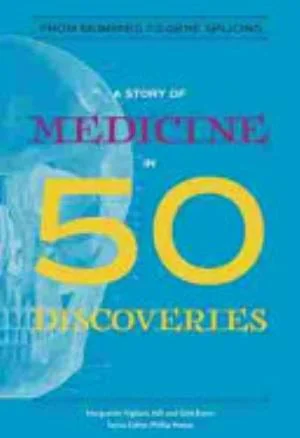
A Story of Medicine in 50 Discoveries
- Publication Date:
- January 15th, 2019
- Publisher:
- History in 50
- ISBN-13:
- 9780884484110
- ISBN-10:
- 0884484114
Why A Story of Medicine in 50 Discoveries Has Been Challenged
The pushback this title has drawn has less to do with how the history is told than with a handful of medical topics it covers, which some have deemed too sensitive for the shelf or classroom where it appeared. See more ↓
Challenged or banned in 1 state across 1 school district.
Overview
Marguerite Vigliani's A Story of Medicine in 50 Discoveries traces the history of medical knowledge through a sequence of pivotal moments, each treated as its own short chapter. Rather than a continuous narrative, the book moves episodically, stopping at the innovations, mistakes, and reversals that reshaped how clinicians understand the body and treat illness.
The structure is deliberately accessible: each discovery is introduced, situated in its historical moment, and then connected to the practice that followed from it. Readers move from early observational medicine through the rise of laboratory science, into the development of interventions and diagnostic tools that define contemporary healthcare.
Because the book distills large, technical subjects into digestible units, it has found a natural home in introductory health-sciences coursework, where it functions less as a specialized text and more as an orientation to how the field came to know what it knows.
Medicine's History as a Story of Revision
What the book is really tracking is not triumph but correction. Medicine advances, in Vigliani's telling, largely by discarding confident wrong answers in favor of better ones — a pattern that recurs across eras and specialties. This framing gives the book a quieter, more reflective character than a simple catalog of achievements would suggest; it treats uncertainty and error as part of the discipline rather than an embarrassment to be skipped over.
That emphasis also explains its appeal to nursing and allied-health instruction. Students entering clinical fields benefit from seeing medicine as a discipline still in motion, shaped by debate and revised understanding, rather than as a fixed body of settled fact to be memorized.
Why A Story of Medicine in 50 Discoveries Has Been Challenged
In the settings where it is assigned, the book is generally regarded as a straightforward, well-organized primer — valued precisely for making technical history legible to newcomers. The objection that has surfaced against it, recorded in this catalog in one state and one district, comes from a different angle entirely, aimed less at its craft than at which discoveries it includes.
The friction centers on chapters covering reproductive and sexual health milestones — developments in contraception, anatomy, and related areas of clinical science — which some reviewers have treated as unsuitable for the age or setting in which the book was shelved or assigned. The concern is less about accuracy than about exposure: whether factual medical history on these subjects belongs in a given classroom or library collection at all, independent of how clinically it is presented.
Where to Buy




Affiliate links may generate a small commission at no extra cost to you, which helps support this site.
Banned in Schools
Banned or challenged in 1 state across 1 school district.
Tennessee 1 district
- Oak Ridge Schools Banned