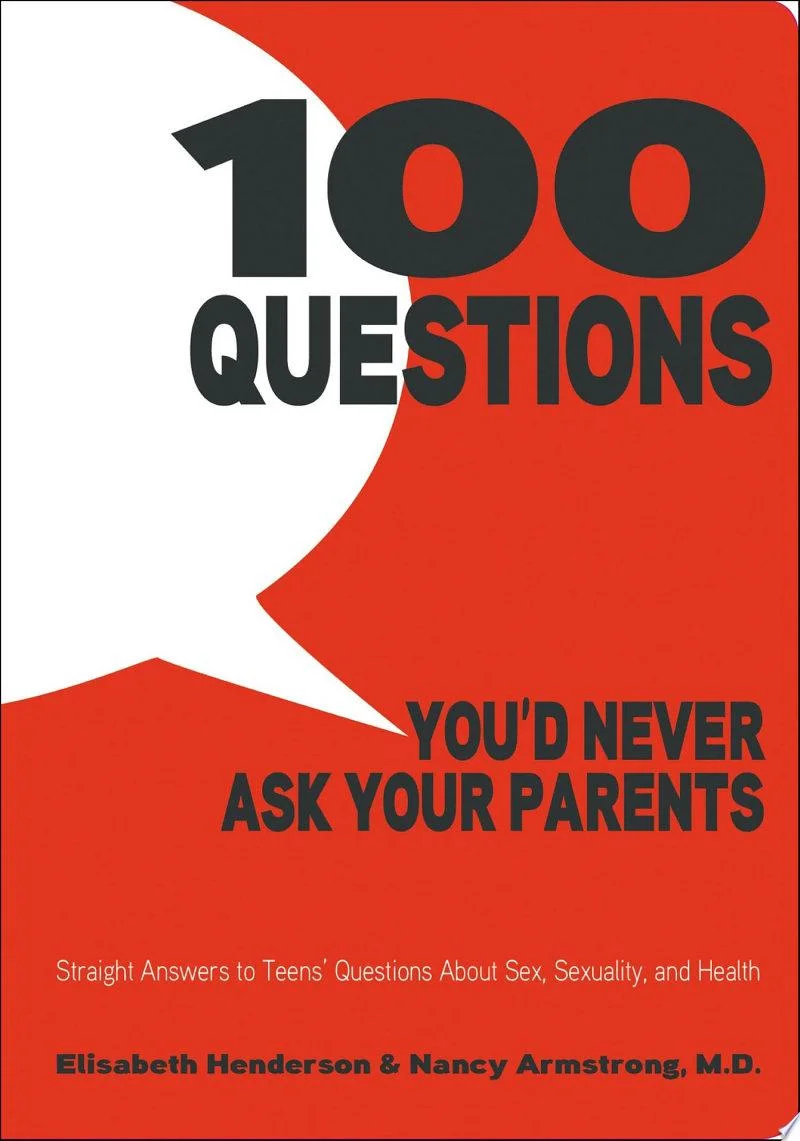
100 Questions You'd Never Ask Your Parents
- Publication Date:
- August 27th, 2013
- Publisher:
- Macmillan + ORM
- ISBN-13:
- 9781596438699
- ISBN-10:
- 159643869X
- Pages:
- 137
Why 100 Questions You'd Never Ask Your Parents Has Been Challenged
Objections to this title center on its explicit treatment of sexual topics for a teenage readership, including direct discussion of sexual acts, arousal, and masturbation without euphemism. See more ↓
Challenged or banned in 1 state across 1 school district.
Overview
Structured as a straightforward question-and-answer reference, this book collects the kinds of questions adolescents raise about their changing bodies and emerging sexuality but often hesitate to ask an adult directly. Authors Elisabeth Henderson and Dr. Nancy Armstrong built the text around inquiries gathered from actual teenagers, then organized clear, factual answers around them.
The scope extends past sex alone to cover related concerns about substance use, physical development, and emotional well-being, treating the four areas as connected parts of adolescent life rather than isolated topics. The format favors brevity and directness over narrative, letting readers locate a specific concern quickly.
Its stated aim is to close the gap between the questions teens actually have and the uneven, sometimes unreliable sources they might otherwise turn to for answers.
Context and Reception
The book belongs to a familiar genre of adolescent health guides that emerged from the observation that teenagers often gather information about sex and their bodies from peers, media, or the internet rather than parents or clinicians, with mixed reliability. By presenting itself as sourced from teens' own questions, it positions itself as responsive to real curiosity rather than imposing a prescribed curriculum, and it frames its subject matter as continuous with broader adolescent health rather than a separate, taboo category.
That framing sits at the center of ongoing debates about how much direct information young readers should receive about sex and drugs, and whether that information belongs in schools and libraries or should be left to parents. The book's straightforward, nonjudgmental tone places it firmly on one side of that debate, treating candid answers as a form of care rather than a risk in themselves.
Why 100 Questions You'd Never Ask Your Parents Has Been Challenged
Objections to this title center on its explicit treatment of sexual topics for a teenage readership, including direct discussion of sexual acts, arousal, and masturbation without euphemism. Critics have argued that material of this kind is inappropriate for minors to access in a school or library setting, regardless of its educational framing, and that its Q&A format makes sexually explicit content unusually easy to locate and read out of context.
The book's willingness to address drug and alcohol use alongside sex has drawn additional concern from those who worry that answering such questions plainly, without a stated moral position, could be read as normalizing the behaviors rather than simply informing readers about them. Supporters counter that withholding accurate information does not reduce risk and that a reliable, judgment-free resource serves teens better than silence or misinformation. In the catalog tracked here, the book has been challenged in 1 state and 1 school district.
Where to Buy




Affiliate links may generate a small commission at no extra cost to you, which helps support this site.
Banned in Schools
Banned or challenged in 1 state across 1 school district.
Tennessee 1 district
- Oak Ridge Schools Banned