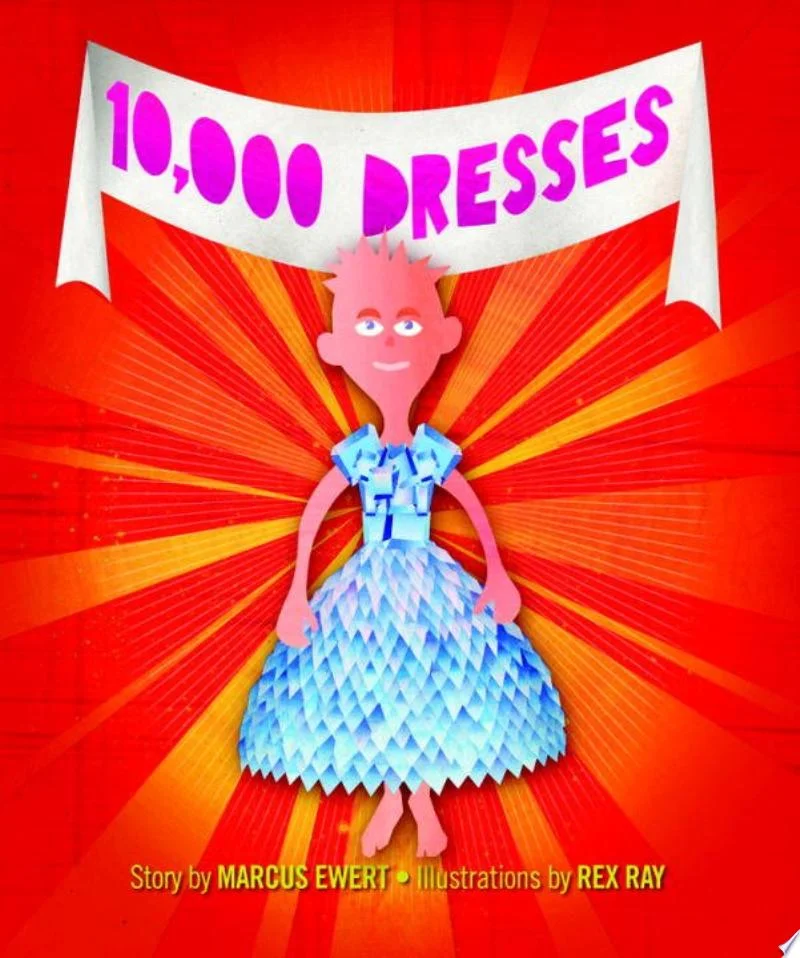
10,000 Dresses
by Marcus Ewert
- Publication Date:
- January 4th, 2011
- Publisher:
- Seven Stories Press
- ISBN-13:
- 9781583229507
- ISBN-10:
- 1583229507
- Pages:
- 34
Why 10,000 Dresses Has Been Challenged
Objections to "10,000 Dresses" center on its portrayal of a child who identifies with a gender different from the one assigned at birth, and on the parents' rejection of that identity being shown sympathetically toward Bailey rather than toward the parents. See more ↓
Challenged or banned in 1 state across 1 school district.
Overview
"10,000 Dresses" follows Bailey, a child whose sleep is filled with elaborate visions of gowns spun from crystal, blossoms, and light. Each morning, Bailey tries to share the wonder of these dreams, only to be shut down by parents who insist that dresses have no place in Bailey's imagination because of the body Bailey was born into.
The story shifts when Bailey meets Laurel, an older neighbor who listens without judgment and responds with genuine curiosity. Rather than dismissing Bailey's visions, Laurel becomes a collaborator, and the two set out to turn the imagined dresses into something real.
What begins as a story of repeated rejection becomes one of partnership and craft. Marcus Ewert frames the turning point not as a solitary triumph but as the product of an intergenerational friendship, suggesting that affirmation often arrives through unexpected allies rather than family alone.
Context and Reception
Published in 2008 with illustrations by Rex Ray, "10,000 Dresses" is frequently cited as one of the first widely distributed picture books to center a transgender or gender-nonconforming child as its protagonist, told without clinical framing or an adult narrator explaining Bailey's identity to the reader. The book presents Bailey's inner life on its own terms, treating the dresses less as a plot device than as an extension of who Bailey already is.
The collaboration between Bailey and Laurel gives the book a distinct throughline within children's literature about gender identity: validation comes through making something together, not through a single conversation or reveal. This has made the book a recurring reference point in discussions of early LGBTQ+ representation in picture books, and it is often paired with later titles that address similar themes with older audiences in mind.
Why 10,000 Dresses Has Been Challenged
Objections to "10,000 Dresses" center on its portrayal of a child who identifies with a gender different from the one assigned at birth, and on the parents' rejection of that identity being shown sympathetically toward Bailey rather than toward the parents. Critics of the book have argued that its subject matter is inappropriate for the picture-book age range, or that it introduces concepts of gender identity to young readers before they are, in the critics' view, prepared to engage with them. Some challenges have also framed the book as promoting a particular viewpoint on gender rather than presenting neutral information. In this catalog, the book has been formally challenged in one state and one school district.
Where to Buy




Affiliate links may generate a small commission at no extra cost to you, which helps support this site.
Banned in Schools
Banned or challenged in 1 state across 1 school district.